Browse categories
Explore
Fiverr Pro
English
$
USD

Level 2


CUSTOM LLM FINE-TUNING
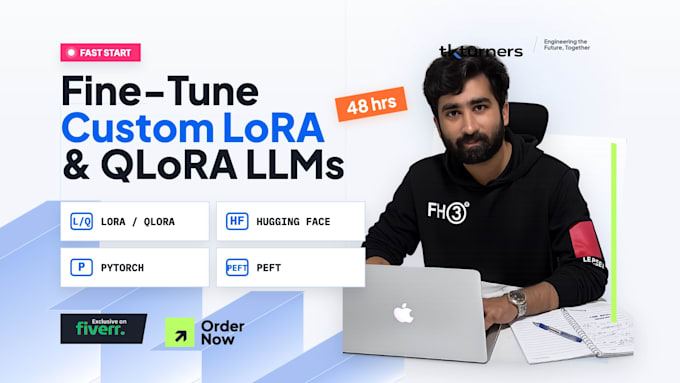
Generic AI models can hallucinate or fail on your business workflows. Fine-tune them with your proprietary data, formatting, and domain knowledge.
DELIVERABLES & SPEED
THE SOLUTION
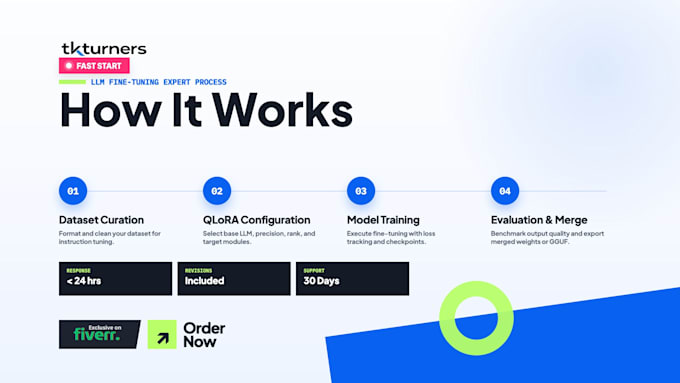
We build clean instruction datasets, optimize rank/alpha parameters, and fine-tune models for better domain performance and lower inference costs.
WHY TKTURNERS
Full-stack AI engineers delivering production-ready models and workflow automation tailored to your business needs.
QUALITY GUARANTEE
Every model is benchmarked against agreed test prompts. If results miss the target metrics, we retrain at no extra cost.
FREE AI AUDIT
Message before ordering for a free 15-minute dataset audit & model architecture recommendation.
Senior Software Engineer
Level 2
Languages
Why should I message you before ordering?
Messaging beforehand allows us to evaluate your dataset size, verify base model compatibility (e.g., Llama 3, Mistral), and confirm compute requirements so you get the exact right package.
What base LLM architectures do you support for fine-tuning?
We support Llama 3/3.1, Mistral, Mixtral, Gemma 2, Qwen 2.5, DeepSeek, Falcon, and any custom open-weights model hosted on Hugging Face.
What is the difference between LoRA and QLoRA?
LoRA trains low-rank adapter matrices to adapt a model efficiently. QLoRA quantizes the base model to 4-bit precision during training, drastically reducing GPU VRAM requirements while retaining peak model accuracy.
Who covers the GPU compute and cloud infrastructure costs?
Compute costs (RunPod, Lambda Labs, Google Colab Pro, or Hugging Face Inference Endpoints) are paid directly by the client. We guide you on the most cost-effective GPU setup.
In what format should my dataset be provided?
You can provide your data in JSON, JSONL, CSV, or raw text. We clean, validate, and convert it into standard instruction formats like Alpaca, ShareGPT, or ChatML.
What exact deliverables will I receive upon project completion?
You will receive trained LoRA adapter weights, the merged standalone model (if requested), GGUF quantized files for Ollama/LM Studio, test scripts, and evaluation metrics.
Can you deploy the fine-tuned model to an API or private cloud?
Yes. We can deploy your trained model to Hugging Face Dedicated Endpoints, RunPod serverless, vLLM, Ollama, or a custom FastAPI backend on AWS/GCP.
What third-party API or platform access will you need?
We may need read/write access to your Hugging Face account (access token) and your chosen GPU cloud platform (RunPod, Lambda Labs, or AWS) via API keys or temporary credentials.
How do you handle revisions and benchmark performance?
Each tier includes revisions to tune learning rates, epochs, or rank/alpha parameters. We evaluate your model against validation hold-out sets to verify quality.
Do you offer post-delivery support and maintenance?
Yes, we offer ongoing maintenance and retainer support for periodic dataset ingestion, model retraining, and cloud inference scaling.