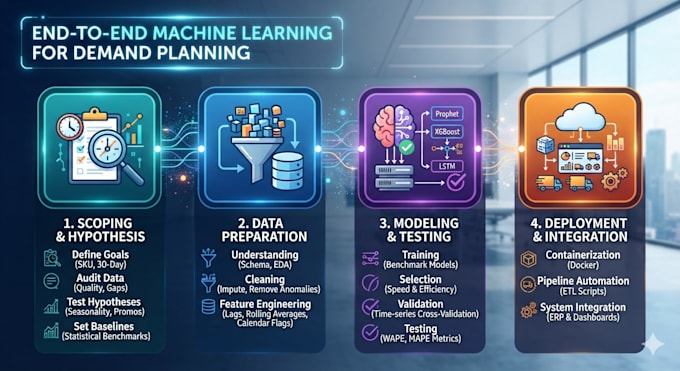
1. Scoping & Hypothesis
- Define Goals: Set the prediction horizon (e.g., 30-day SKU level) and target metrics (e.g., lower stockouts).
- Audit Data: Check the depth, quality, and gaps of historical sales and inventory logs.
- Test Hypotheses: Verify seasonal trends and confirm if promotions or weather statistically affect demand.
- Set Baselines: Establish a simple statistical benchmark to measure ML performance against.
2. Data Preparation
- Understanding: Profile schemas, identify data relationships, and perform Exploratory Data Analysis (EDA).
- Cleaning: Impute missing timestamps, smooth out supply chain anomalies, and standardize formats.
- Feature Engineering: Create lag variables, rolling averages, calendar flags, and price/promotion signals.
3. Modeling & Testing
- Training: Benchmark statistical (Prophet), tree-based (XGBoost/LightGBM), and deep learning (LSTM) models.
- Selection: Evaluate training speeds and system resource efficiency.
- Validation: Run time-series cross-validation to tune hyperparameters without leaking future data.
- Testing: Score the final model on an unseen holdout set using error metrics like WAPE and MAPE.
Package this module [No deployment/integration]