Browse categories
Explore
Fiverr Pro
English
$
USD
Licensed US Corporate Startup Attorney Bar No 150409
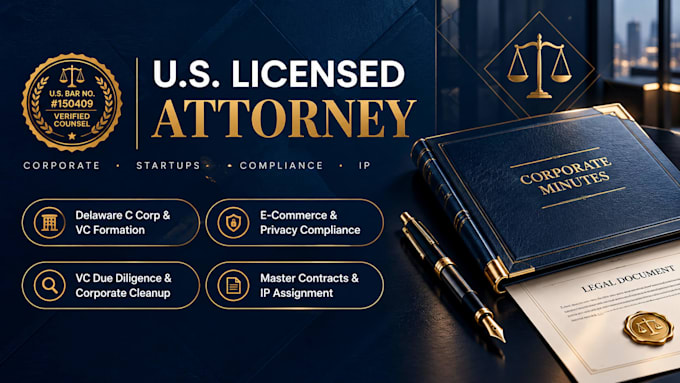
Incomplete corporate formation documents can halt fundraising, cause equity disputes, and trigger adverse tax consequences. I am Dawn Patrice Ross, a licensed U.S. Attorney (Bar #150409), and I draft institutional-grade Delaware C Corporation documentation engineered specifically for venture capital scrutiny.
Whether you are launching a SaaS startup, preparing for an accelerator, or issuing founder equity, I protect your legal interests from day one.
What I Deliver:
Delaware Certificate of Incorporation (Authorized shares & stock structuring)
Comprehensive Corporate Bylaws (Governance rules, voting thresholds)
Founder Restricted Stock Purchase Agreements (RSPAs) with 4-year vesting schedules and acceleration terms
Crucial Section 83(b) Election forms and IRS filing packages
Proprietary Information and Inventions Assignment Agreements (CIIAA) to secure all IP
Every document is custom-drafted to mirror Silicon Valley VC standardsno generic web templates. Select your package to establish your corporation properly, or message me with your setup details.

Field of law:
Entertainment
Target country:
United States
Please note that there is no screening process for this service. We recommend that you message the freelancer and check all necessary details before placing your order. Pro freelancers in this category have gone through a vetting process. You can find more details here.
1. Why should I incorporate as a Delaware C Corporation?
Delaware is the benchmark jurisdiction for venture-backed companies. Institutional venture capitalists, angel investors, and accelerators (such as Y Combinator) expect a Delaware C Corp structure due to Delaware's established corporate law, business-focused Court of Chancery.
2. What is an 83(b) Election, and why is it critical?
An 83(b) election notifies the IRS that you elect to pay taxes on your restricted equity at the time it is granted rather than as it vests. Missing the strict 30-day IRS filing deadline can result in massive tax liabilities as your company’s valuation increases over time.
3. Do you handle the physical filing with the Delaware Division of Corporations?
I deliver complete, execution-ready formation filings and corporate governance suites. You submit the Certificate of Incorporation directly through the state portal or via your registered agent, ensuring you maintain direct control of your filing fees, state records, and official communications.
4. How does the Intellectual Property (CIIAA) assignment protect the company?
The Confidential Information and Inventions Assignment Agreement (CIIAA) legally transfers all technology, code, domain names, and trademarks created by founders and team members to the corporate entity. Investors will not wire funds without a clean, unbroken IP chain of title.
5. How do vesting schedules work in these agreements?
Standard institutional vesting follows a 4-year term with a 1-year "cliff." If a co-founder leaves within the first 12 months, they forfeit their unvested equity, protecting the remaining founders and cap table integrity. Custom vesting schedules can be implemented upon request.
