Browse categories
English
$
USD
Connect to your AI
Licensed U S Attorney Premium Contracts and Corporate Legal Solutions
Welcome. I am Frank Oliver Fox, a licensed U.S. attorney (Bar# 117780), specializing in brand protection and corporate law.
Licensing your trademark is a highly lucrative way to scale your brand, but doing it without proper "Quality Control" clauses can result in the legal abandonment of your trademark under U.S. law. You need an attorney who understands the nuances of trademark protection.
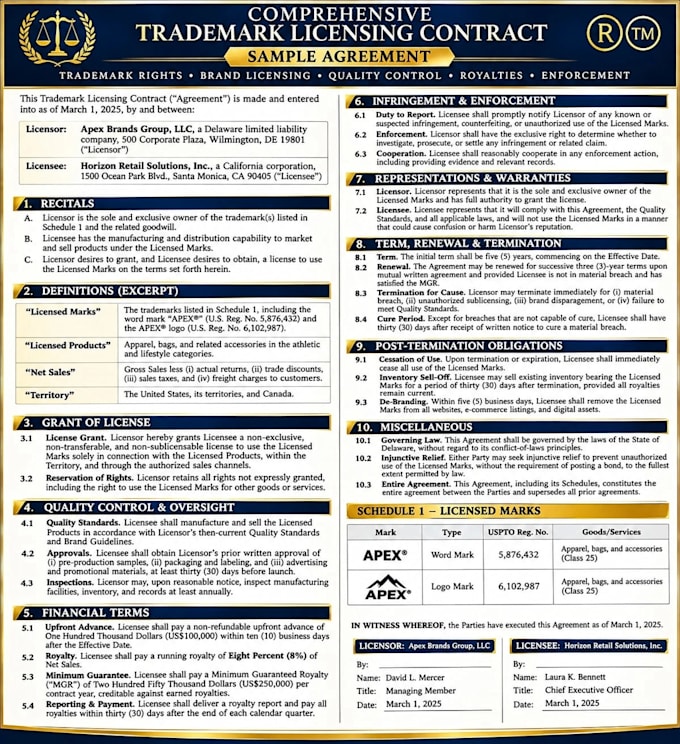
I Will Provide a Contract That Covers:
Whether you are licensing your brand to a clothing manufacturer, a franchise, or an international distributor, I will draft an airtight agreement that maximizes your profits while shielding your trademark's legal validity.
Protect your brand's equityorder today.



Field of law:
Business (corporate)
Document type:
License agreement
Please note that there is no screening process for this service. We recommend that you message the freelancer and check all necessary details before placing your order. Pro freelancers in this category have gone through a vetting process. You can find more details here.
What is a comprehensive trademark licensing contract?
A trademark licensing contract is a legally binding agreement where the owner of a registered brand or logo (licensor) grants permission to another party (licensee) to use the trademark for commercial products or services in exchange for royalty payments, while retaining full brand ownership.
Why is a quality control clause essential in a trademark license agreement?
A strict quality control clause is mandatory under trademark law to prevent "naked licensing." If a licensor fails to supervise the quality of goods or services offered under their mark, the USPTO or courts may deem the trademark abandoned. My contracts include customized quality oversight protocols
Can you draft both exclusive and non-exclusive trademark licensing agreements?
Yes. I draft exclusive trademark licenses (granting sole market or territorial rights to one licensee), non-exclusive trademark licenses (allowing multiple licensees), and sole licenses based on your specific commercial strategy.
How are royalties, advance fees, and payment terms structured?
Your trademark licensing contract will clearly specify net vs. gross sales definitions, percentage-based trademark royalties, upfront advances, minimum guaranteed royalties, payment schedules, and late payment penalties to secure your revenue stream.
Does this contract define territory restrictions and permitted channels?
Yes. I draft precise geographic territory restrictions (domestic or international jurisdictions) and define authorized distribution channels (e.g., e-commerce, retail, wholesale, or social commerce) to stop unauthorized brand dilution.
What provisions protect my brand in case of trademark infringement?
The agreement clearly allocates responsibilities between the licensor and licensee for monitoring market abuse, funding trademark infringement litigation, taking down counterfeiters, and distributing financial damages recovered from lawsuits.
Can you draft a trademark licensing agreement for merchandise, fashion, or apparel?
Yes. I regularly draft brand merchandise licensing contracts for clothing lines, consumer goods, digital products, and character trademarks, integrating specifications for packaging, labeling, and promotional rights.
How does the termination clause protect my brand reputation?
I include robust termination clauses that allow immediate revocation of the trademark license if the licensee engages in criminal acts, brand disparagement, substandard product manufacturing, or insolvency, complete with an expedited post-termination inventory sell-off protocol.
Can an unregistered common law trademark be licensed with this contract?
Yes. While a USPTO registered trademark provides broader protection, common law trademarks can still be licensed. I tailor the agreement’s representations and warranties to accurately reflect your current trademark registration status.
Does this trademark agreement allow the licensee to grant sub-licenses?
By default, I restrict unauthorized sub-licensing rights to prevent third parties from exploiting your brand. If sub-licensing is desired, I draft clear terms requiring prior written licensor approval and revenue-sharing mechanisms.