Browse categories
Explore
Fiverr Pro
English
$
USD
POWER SHOULD FIT THE PRODUCT NOT THE OTHER WAY AROUND.
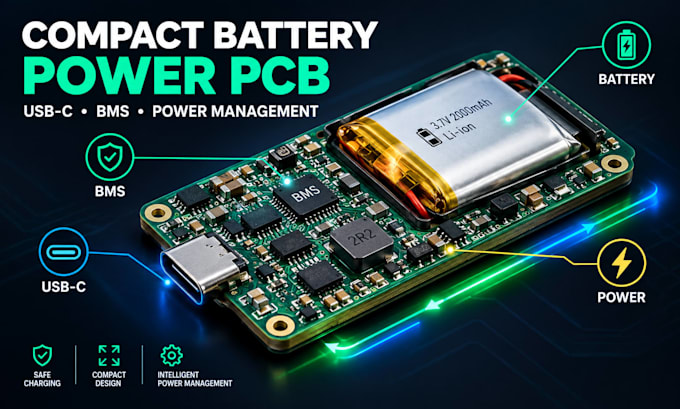
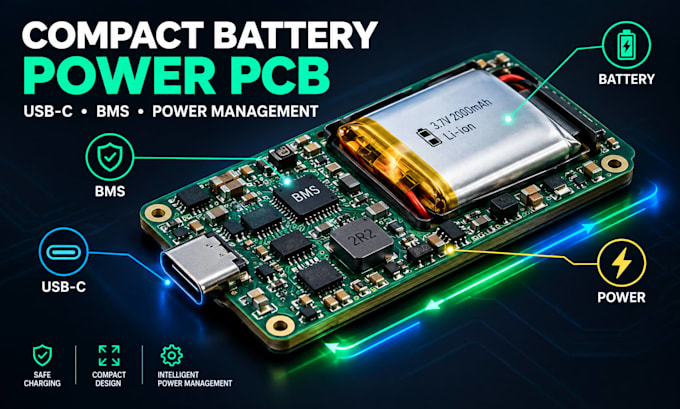
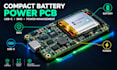
I build compact battery power PCBs that bring USB-C charging, BMS protection, voltage regulation, and power control into one reliable board.
From a single cell portable device to a compact battery powered product, I focus on clean power paths, sensible component selection, and layouts that respect real enclosure limits.
POWER ARCHITECTURE:
ENGINEERING GAINS:
BUILD FOCUS:
BOARD ADVANTAGE:
WHY THIS MATTERS?
Your battery board sits between the charger, battery, and the rest of the product. I structure the circuit around the actual battery chemistry, cell count, charging current, output requirements, and enclosure constraints.
Bring me your battery, USB-C, voltage, current, and size requirements and let's turn them into a
Can I manufacture the PCB from the files you provide?
Yes. The project can include Gerbers, drill files, BOM, schematic, PCB source files, and manufacturing references, giving your assembler the information needed to reproduce the board without rebuilding the project from scratch.
Will the USB-C section actually suit my product's power requirements?
The USB-C input is selected around your required input voltage, charging current, power path, and regulation needs. Where applicable, I also account for the USB-C power negotiation requirements rather than treating the connector as just a socket.
What happens when the board must fit into a very small enclosure?
Compact size is considered from the beginning. I account for component clearance, connector placement, heat-producing parts, routing space, and enclosure limits before finalizing the PCB layout.
How do you prevent charging or power faults?
The circuit is structured around overcharge, over-discharge, overcurrent, short-circuit, and thermal protection requirements. Protection thresholds and power paths are reviewed against the intended operating conditions.
Will the BMS match my exact battery configuration?
Yes. I base the BMS and charging architecture on your battery chemistry, cell count, capacity, charge current, discharge current, and required protections not on a generic reference circuit.