Browse categories
English
$
USD
Connect to your AI
Web Application Security Analyst specializing in OWASP Top 10
Get a clear, scored picture of how the application stands against the OWASP Top 10 before spending budget on a full penetration test.
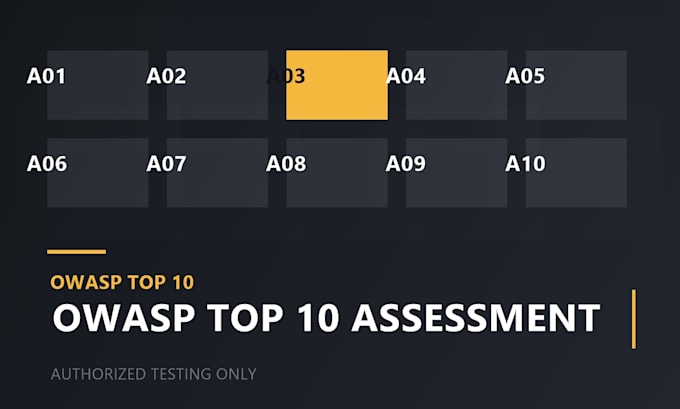
Each category is tested and then verified by hand: injection including SQL injection and XSS, broken access control, authentication and session failures, insecure design, security misconfiguration, vulnerable components, integrity failures, logging gaps and SSRF.
Burp Suite, OWASP ZAP, Nuclei, ffuf and sqlmap provide coverage, while manual request tampering and multi-account testing confirm what is genuinely exploitable before it reaches the report.
Deliverables: an executive summary, a CVSS-scored findings table, step-by-step reproduction, curl and Python proof-of-concept requests, and a remediation priority table ranked by business risk rather than raw scanner severity.
Testing is limited to client-owned assets or explicitly authorized targets, with no third-party exploitation, no malware and no denial-of-service activity. The scope agreement is confirmed before the first request.
What I need from you: the application URL, a test account and any API documentation. Written authorisation from the asset owner is required before testing .
Testing application:
Web application
Device:
PC
•
Linux
How is this different from a full penetration test?
This is a focused assessment mapped to the OWASP Top 10 categories, delivered as a scored findings report with remediation priorities. A full penetration test goes further: deeper business logic analysis, chained attack paths, multi-role abuse scenarios and an optional retest after fixes.
Do I need test credentials?
Yes, for the highest-signal results. Provide one account per relevant role, such as guest, standard user and administrator, plus the target URL. Staging access is preferred, and the credentials are used only inside the authorized engagement.
What do I receive at the end?
An executive summary, a CVSS-scored findings table, step-by-step reproduction steps, curl and Python proof-of-concept requests, and a remediation priority table that ranks issues by business impact and fix effort for the engineering team.
Which vulnerability classes are covered?
Broken access control, cryptographic failures, injection including SQL injection and XSS, insecure design, security misconfiguration, vulnerable and outdated components, authentication and session failures, software and data integrity failures, logging and monitoring gaps, and SSRF.
Will you use automated scanners?
Yes, as a coverage aid. Burp Suite, OWASP ZAP, Nuclei and sqlmap enumerate inputs and collect evidence, but every issue is manually verified and reproduced before it enters the report, so duplicate and false-positive scanner noise is removed.