Browse categories
Explore
Fiverr Pro
English
$
USD


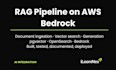
RAG is easy to demo and hard to ship. Most "chat with your docs" projects fall apart the moment real users hit them. Retrieval returns irrelevant chunks. Citations don't track back to source documents. Context windows blow up the cost per query. Answers hallucinate because the retrieval layer was never actually tuned. The demo worked. Production doesn't.
I build RAG the way backend engineers build any production system. Start with real document chunking, not default splitters. Embeddings into pgvector or OpenSearch with a retrieval layer you can actually debug. Generation on AWS Bedrock with Claude or Titan models. Citation tracking so answers point back to source. Metadata filtering so users only retrieve from documents they're allowed to see.
I have hands-on Bedrock experience from the AWS AI and ML Scholars program plus production backend depth from 4+ years of shipping systems that handle real traffic. The retrieval and generation code is the interesting part. The infrastructure around it is the part that decides whether your RAG actually works in production.
Message me with what you want to make queryable.
Senior backend engineer
Languages
What kinds of documents can you work with?
PDFs, Word documents, markdown, plain text, HTML, and structured data like CSVs or JSON. I've worked with mixed document sets including technical documentation, legal contracts, internal knowledge bases, and support ticket archives.
Why AWS Bedrock instead of OpenAI?
Bedrock makes sense if you're already on AWS, need models running in your VPC for compliance, want access to multiple model families through one API (Anthropic Claude, Amazon Titan, Meta Llama, Cohere, and others), or have enterprise procurement that favors AWS.
