Browse categories
Explore
Fiverr Pro
English
$
USD



Stuck with a broken Claude Code setup, endless MCP errors, or a Notion workspace still running on manual copy-paste?
You're not alone. Most teams waste weeks trying to wire Claude Code, Claude Cowork, and MCP servers together without ever getting a working agent architecture. That stops here.
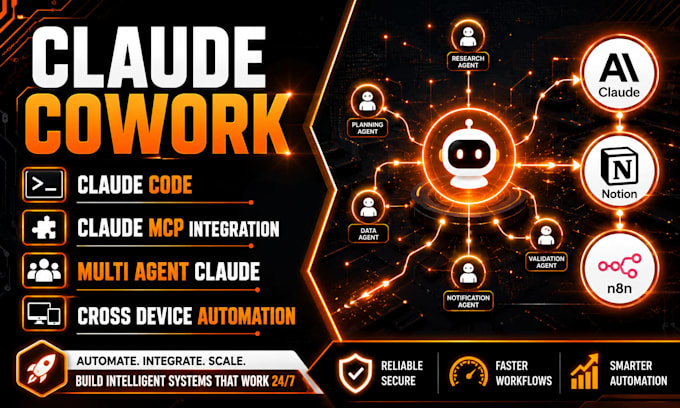
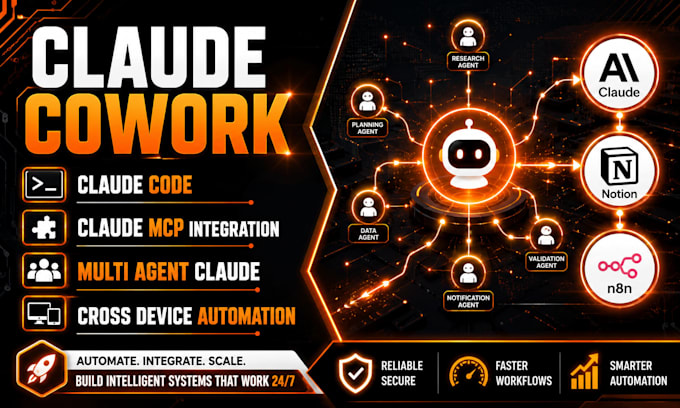
I build production ready Claude Code AI agents: clean subagent architecture, proper CLAUDE.md conventions, validation gates, retry logic, and 24/7 automation loops that actually run unattended. I set up Claude Cowork for technical and non-technical teams alike, and connect Claude MCP servers to Notion, CRMs, and n8n with zero UI automation strict JSON, rate-limit-safe, built to survive production traffic, not just a demo.
Right now Cowork just went live on mobile and web, and businesses are racing to automate real work, not just chat with AI. I help you move fast: reliable subagent pipelines, clean Notion + MCP integration, and Claude Code setups built to scale.
Need a fresh Claude Code AI agent setup, a full Claude Cowork rollout, or a broken build audited and fixed? I deliver working systems, not just code.
Ready to automate your workflow properly? Message me and let's get started now.
Full Stack AI Developer No Code And LowCode
Languages
What's the difference between Claude Code and Claude Cowork, and do I need both?
Claude Code works directly in your codebase, follows CLAUDE.md conventions, and handles subagent orchestration. Claude Cowork is designed for broader business work (reports, spreadsheets, CRM tasks, research) and now runs on desktop, web, and mobile. Many clients need only one
How do you structure subagents so they don't conflict with each other?
I define clear ownership boundaries per subagent (research, execution, validation, etc.), route communication through a structured protocol rather than shared free-form context, and set validation gates between phases so one agent's output is checked before the next agent acts on it.
What exactly goes into a CLAUDE.md file, and why does it matter?
CLAUDE.md defines your project's conventions coding style, folder structure, tool permissions, and how subagents should behave in your specific codebase. Without it, Claude Code falls back to generic defaults, which is where most inconsistent or off-spec output comes from.
Can you integrate Claude MCP with Notion without breaking on schema changes?
Yes. I build MCP connections with defensive error handling around Notion's schema and API limits, so a renamed property or shifted database structure doesn't silently break your pipeline. You'll also get logging so failures are visible instead of failing silently.
Do you use browser automation for API integrations?
No, by default. I build direct API integrations with proper authentication and structured JSON responses — this is more reliable and won't break when a platform updates its UI. Browser automation is only used as a fallback when a platform has no API access and I'll flag that tradeoff upfront.
Can you fix a Claude Code project someone else started that's half broken?
Yes this is one of my most common jobs. I start with an audit: I map what's built, what's missing, and what's misconfigured, then give you a written report before touching anything, so you know the scope before I start fixing.
Will my Claude Cowork agent have access to sensitive data across our tools?
Only what you explicitly grant. Cowork's permission model lets you scope access by folder and tool, and requires approval before deleting or shipping anything significant. I configure permissions conservatively by default and walk you through exactly what's connected.
How do you connect n8n workflows with Claude agents without duplicate logic?
I keep decision making and reasoning inside the Claude agent layer, and use n8n purely for orchestration/triggers between systems (CRM, email, Slack). This avoids the common mistake of duplicating business logic in both places, which causes drift when one gets updated and the other doesn't.