Browse categories
Explore
Fiverr Pro
English
$
USD
Drone Vision, Computer Vision Specialist Turning Aerial Data into Actionable
Are your aerial videos trapped as raw data? Shaky footage, missed objects, changing lighting, and manual review bottlenecks often ruin drone data collection. I turn your raw aerial video feeds into actionable, automated intelligence using state-of-the-art computer vision models.
Whether you need precision object tracking, asset mapping, or automated vehicle tracking, I build custom AI pipelines that solve your operational challenges. Stop wasting hours on manual video scrubbing; my solutions extract automated insights fast.
What I Fix for You:
My Approach:
Lets eliminate your data bottlenecks. Send over your sample footage today, and lets turn your aerial views into intelligent, automated decisions!
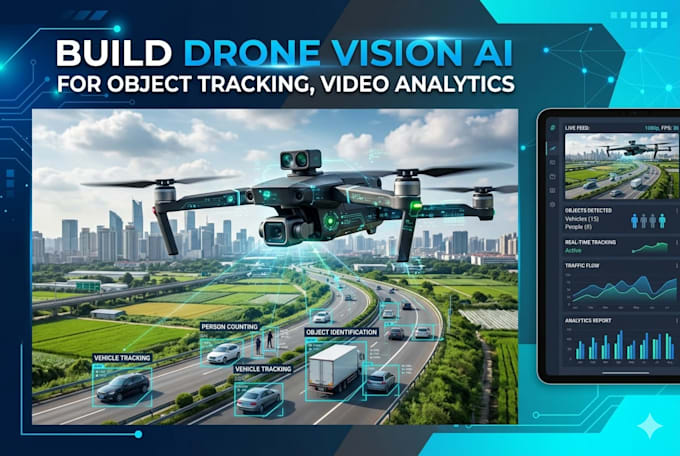

How does your AI pipeline handle target occlusion, scaling issues, or sudden drone altitude shifts?
I implement advanced Kalman filtering and DeepSORT tracking algorithms alongside custom-anchored bounding boxes. This ensures that even if an object is temporarily blocked by a tree or changes size due to altitude shifts, the system retains the object ID and resumes tracking
Drone video formats and angles vary wildly. How do you prevent high false-positive rates?
Top-down aerial perspective data behaves differently than ground footage. I use domain-specific data augmentation (random rotation, nadir-angle adjustments, and simulated atmospheric haze) during training.
Can this system run locally on low-power edge devices, or does it require expensive cloud GPUs?
optimize model weights using quantization techniques (like TensorRT or ONNX conversion). If you need real-time fields on a ground station or an embedded onboard computer (like a Jetson), I lean out the architecture for fast edge inference.
