Browse categories
Explore
Fiverr Pro
English
$
USD


About This Gig
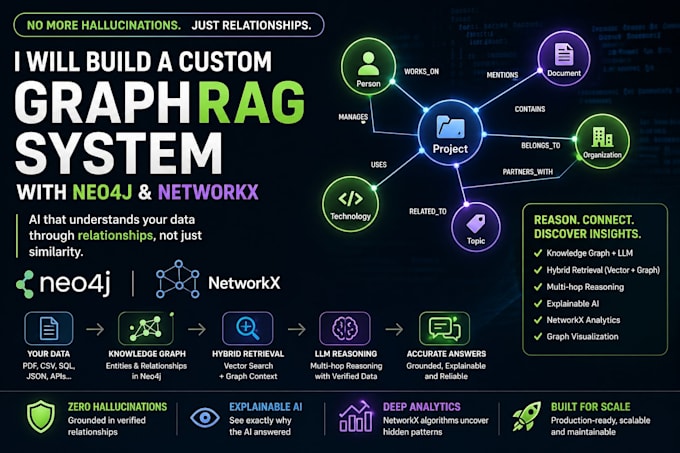
If your AI is having trouble with connecting data from multiple sources meaningfully, you need a better system that introduces relationships in your data. I build GraphRAG systems using Neo4j and NetworkX to improve AI performance & reasoning.
Basic
Target: Perfect for validating your data structure or a small-scale pilot.
Standard
Target: For teams that need high-accuracy AI for their specific internal data.
Premium
AI Engineer
Languages
What makes your GraphRAG system different from standard RAG or chatbot solutions?
Standard RAG systems rely purely on vector similarity, which often leads to irrelevant or hallucinated answers. My GraphRAG systems use structured relationships in a knowledge graph (Neo4j) combined with vector search. This allows the AI to reason over connected data, improving its response quality.
How do you reduce hallucinations?
Hallucinations are minimized by: 1. Grounding responses in explicit graph relationships 2. Restricting answers to verified data paths 3. Combining graph traversal with retrieval The AI doesn’t invent answers—it derives them from your data structure.
How accurate is the system compared to ChatGPT or standard bots?
For complex, domain-specific queries, GraphRAG systems typically achieve 30–50% higher accuracy because they: 1. Use verified relationships instead of guessing 2. Maintain context across multiple documents 3. Support multi-hop reasoning
What kind of data can you work with?
I can work with most structured and unstructured data formats, including: - PDFs (reports, research papers, legal docs) - CSV / Excel datasets - JSON / APIs - SQL databases - Internal documentation or wikis If your data has relationships hidden inside it, it’s a strong candidate for GraphRAG.
Do I need technical knowledge to use the system?
No. For Standard and Premium plans, I provide a FastAPI backend with simple endpoints that your frontend or internal tools can call. You don’t need to understand graphs or AI internals to use it effectively.
What will I receive at the end of the project?
Depending on the plan, deliverables may include: Graph schema (Neo4j) Data ingestion pipeline Hybrid RAG query system FastAPI backend NetworkX analytics layer (Premium) Graph visualization tools Documentation + support Everything is designed to be usable and extendable, not just a demo.
Can you integrate this with my existing systems or frontend?
Yes. The Standard and Premium plans include an API layer, making it easy to integrate with: Internal dashboards Chat interfaces Web apps Existing AI tools
Can you customize the system for my exact use case?
Absolutely. Every system is tailored to your: - Data structure - Query needs - Business logic This is not a one-size-fits-all chatbot—it’s a custom reasoning engine.
Do you support local/private LLMs?
Yes. I can configure the system to work with: 1. OpenAI (e.g., GPT models) 2. Anthropic Claude 3. Local models like Llama This is especially useful for privacy-sensitive or on-premise deployments.
What do you need from me to get started?
Before starting, I need: 1. Your dataset (PDFs, CSVs, etc.) 2. A clear problem statement (what current AI fails at) 3. (Optional) Sample queries you want the system to answer If you’re unsure, message me and I’ll help define the structure.