Browse categories
Explore
Fiverr Pro
English
$
USD




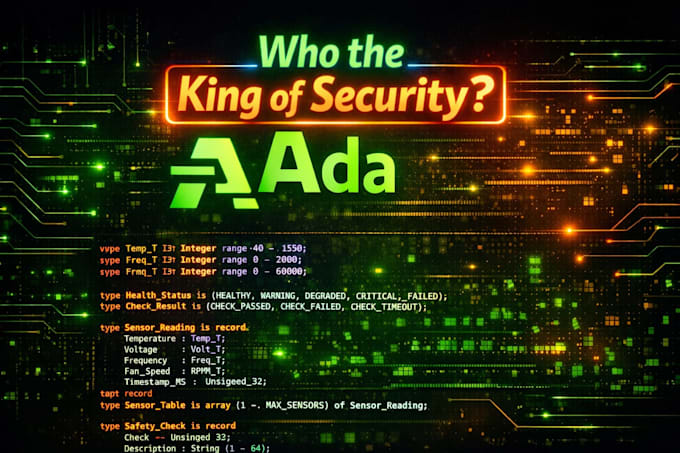
Stop compromising on security. Build your next system with a foundation that is mathematically designed to be unhackable.
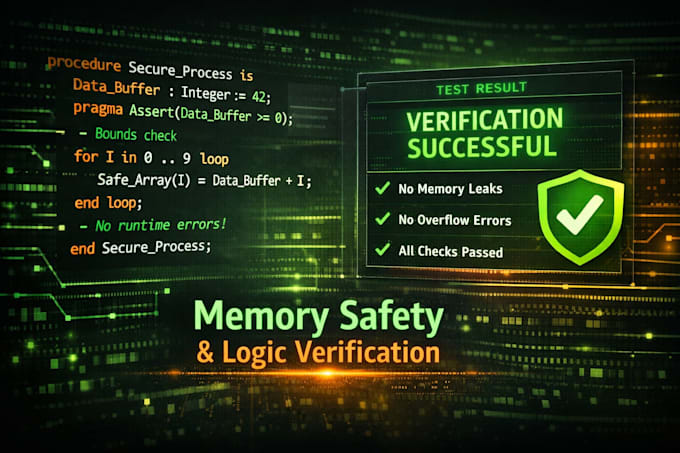
As a low-level systems developer with experience managing codebases exceeding 86,000 lines (NebulaOS project), I offer high-efficiency software development using the Ada programming language. While most developers focus on standard web or mobile apps, I specialize in the "Mission-Critical" domain where memory safety and logic verification are non-negotiable.
Why Choose This Service?
Systems and Web Developer Focused on Efficiency
Languages
Why do you use Ada instead of C++ for secure applications?
While C++ is powerful, Ada is specifically engineered for safety-critical systems. It features strong typing and run-time checks that eliminate entire classes of bugs like buffer overflows, making the code mathematically more secure.
Do you have experience with large-scale system projects?
Yes, I have developed extensive low-level systems, including a custom operating system project (NebulaOS) that exceeded 86,000 lines of code. This involved manual hardware enumeration, firmware status checking, and kernel-level optimization.
Will using Ada impact the performance of my application?
On the contrary, I prioritize high-efficiency computing and resource management. By leveraging Ada's zero-cost abstractions and my experience in low-level optimization, I ensure the code is both ultra-secure and extremely fast.