Browse categories
English
$
USD
Connect to your AI
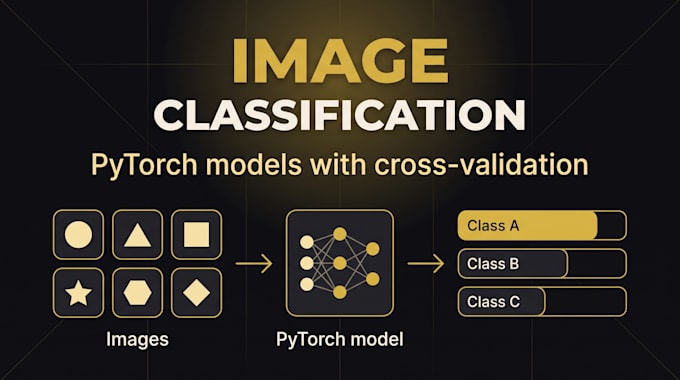
Need your images sorted automatically? I train PyTorch image classification models and evaluate them honestly, so you know how they perform on data they haven't seen.
Every package includes data preprocessing, a fine-tuned model, testing on held-out data, source code and documentation.
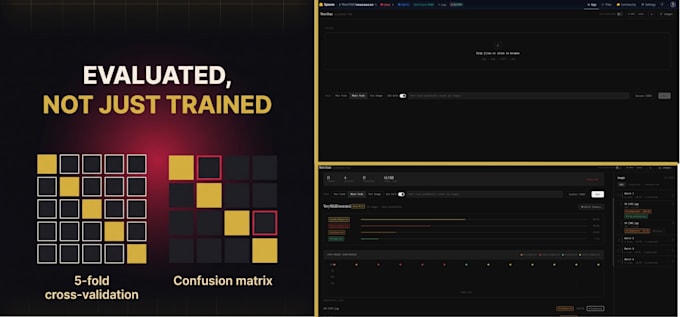
My own project, NeuroScan, classifies 6,400 MRI scans into 4 classes with 98.95% mean macro recall across 5-fold cross-validation (research only, not a clinical tool).
Models: Basic 1, Standard up to 2, Premium up to 3. PyTorch by default; TensorFlow, Keras or object detection on request.
You provide a labelled dataset (up to about 2,000 / 10,000 / 20,000 images by package). I train on Colab; for a bigger GPU you provide access or cover the cost. Hosting costs are yours. I can't promise a specific accuracy, as results depend on your data.
Message me with what you want to classify and a data sample, and I'll recommend a package.



What kind of images and tasks can you handle?
Any image set with labels you can sort into classes: products, documents, defects, plants, scans and more. One label per image works best. Multi-label, segmentation and object detection are different tasks, so message me first.
What do I need to provide?
A labelled dataset, ideally one folder per class or a CSV of image paths and labels, plus a sentence on how the model will be used. A rough guide is at least 100 images per class. Dataset validation is included in Premium, or available as an extra.
Can you guarantee a certain accuracy?
No. Results depend on your data quality, label quality, class balance and task difficulty. I report honest numbers on unseen data, and I’ll tell you early if the data looks too weak for the goal.
What is cross-validation and why does it matter?
Instead of testing once on a single split, the data is split 5 ways and the model is trained and tested 5 times. You get an average and a spread, which shows whether a good score was luck. I include it from the Standard package.
What if some classes have far fewer images than others?
That is common. From Standard I handle it with techniques such as focal loss and class weighting, and I judge the model on metrics like macro recall, not just overall accuracy, so rare classes are not ignored.
Which frameworks and models do you use?
PyTorch by default, using proven pretrained backbones (for example ResNet, EfficientNet or a Vision Transformer) fine-tuned on your data. TensorFlow or Keras is available on request; tell me before ordering so I can confirm the fit.
What will I receive, and what does monitoring mean?
Model weights, source code, a documented pipeline and your results. Standard adds MLflow performance tracking and a FastAPI endpoint in Docker; Premium adds prediction and latency logging plus a walkthrough call. Monitoring means tracking and logging, not live dashboards or alerts.
Do you host the model or the API?
I don’t provide hosting. Premium includes deploying the API to your cloud account, server or a Hugging Face Space; you give me access and pay the hosting costs. Standard gives you a Docker image ready to deploy yourself.
Can I use it for medical or safety-critical decisions?
No. My models are built for general image sorting and research use. My NeuroScan project is a research demo, not a clinical tool. Anything medical or safety-critical needs proper validation and regulatory review outside the scope of this gig.
What happens if I’m not happy with the results?
Mistakes in what I delivered are fixed through your revisions (1 in Basic, 2 in Standard, 3 in Premium). Results depend on your data, so improving them with more data, extra models or longer tuning is a new order or an extra.