Browse categories
Explore
Fiverr Pro
English
$
USD
PCB design
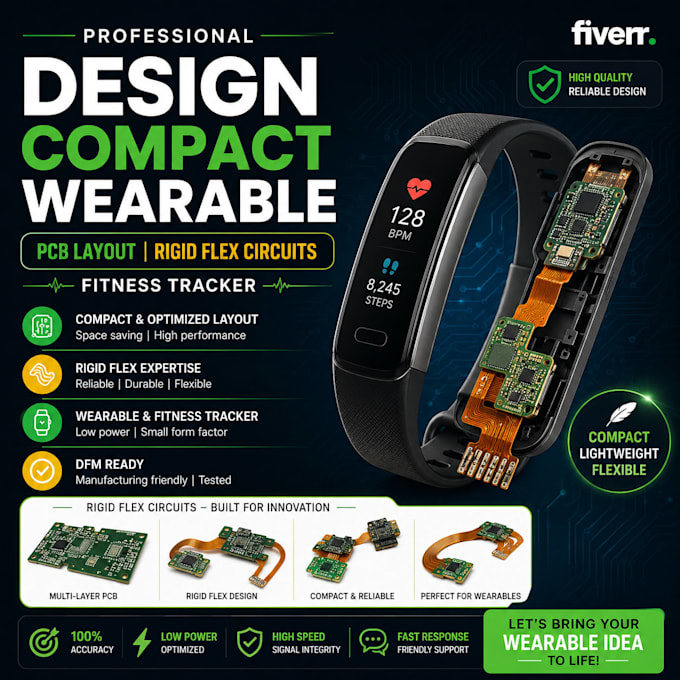
Are you struggling to squeeze your IoT or medical device architecture into a tight, complex mechanical enclosure? Standard rigid PCBs won't cut it for modern wearable technology.
I specialize in ultra-compact, high-density interconnect (HDI) PCB design and Rigid-Flex circuit layouts tailored specifically for smartwatches, fitness trackers, and smart garments. I balance micro-controller integration (ESP32-C3, Nordic nRF52 BLE, ESP8266) with complex battery space limits and physical flexing requirements.
What I Engineer For Your Wearable:
Miniature Layouts: Fine-pitch BGA routing, micro-vias, and optimized 4-to-6 layer stackups.
Rigid-Flex Architecture: Perfect dynamic flexing configurations to prevent trace snapping inside custom enclosures.
Battery & Power Optimization: Designing ultra-low-power standby circuits, charging controllers (PMICs), and battery trace protection.
Wireless Coexistence: Seamless BLE/Wi-Fi antenna isolation and routing to prevent signal dropouts.
What You Will Receive:
Production-ready fabrication files (Gerber X2, NC Drill, IPC-2581).
Clean Bill of Materials (BOM) with ultra-small surface-mount parts (0402/0201 sizes).
3D STEP model of the PCB to drop

Specialization:
Circuit design
•
Schematics
•
Layout
•
Gerber
File format:
Gerber
•
STEP
Software:
Allegro
•
Altium Designer
•
KiCad
•
CircuitMaker
Interface:
I2S
•
UART
•
SPI
•
I2C
•
SDIO
•
Ethernet
What is a rigid-flex PCB and do I need it for my wearable?
A rigid-flex PCB combines flexible plastic film layers with rigid boards. You need it if your wearable curves around a wrist/body, or if you need to connect separate small sensor boards inside an enclosure without using bulky wires.
Can you optimize my layout for low power consumption?
Yes. I select low-dropout regulators (LDOs) and configure hardware isolation so your wearable sensors can sleep without draining the battery.
