Browse categories
Explore
Fiverr Pro
English
$
USD




_kpn7jo.jpg)
_p1uaxm.jpg)
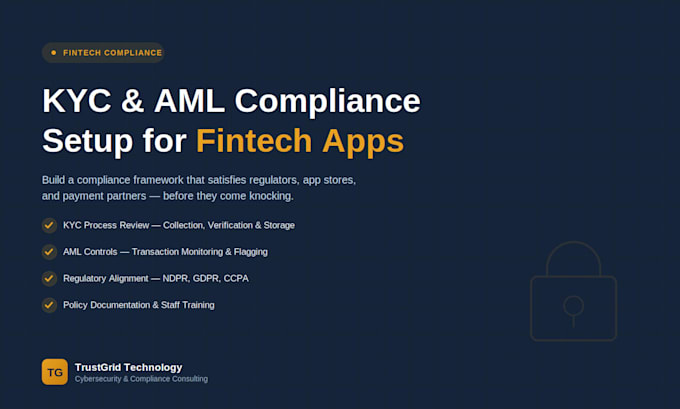
If your fintech or lending app handles user identity, processes loans, or moves money KYC and AML compliance isn't optional. Getting it wrong means app store rejections, regulatory fines, or getting shut down.
I'm Olamide, founder of TrustGrid Technology Limited. I help digital lending companies and fintech startups build KYC and AML compliance frameworks that work in practice, not just on paper.
Recent work: delivered a full KYC/AML compliance review and staff training for ADX Credit Limited, a Nigerian digital lending platform. I identified critical gaps in their KYC document handling, built their compliance framework, and trained their full team on digital lending regulations and data protection.
What I cover: KYC process review collection, verification, and document storage AML controls transaction monitoring and suspicious activity flagging Regulatory alignment NDPR, GDPR, CCPA, and local lending regulations Policy documentation KYC policy, AML policy, data retention Gap analysis and prioritized remediation plan Staff training on compliance obligations
Message me before ordering to discuss your specific situation first.
Cybersecurity Consultant
Languages
Do you work with apps outside Nigeria?
Yes. I work with fintech and lending apps globally. While my primary regulatory experience covers NDPR (Nigeria), GDPR (EU), and CCPA (US), I can align your KYC/AML framework to your specific target market's requirements.
What do you need from me to get started?
A description of your current KYC and AML process (or lack of one), your target market and user base, any existing policies or documentation you already have, and details about how your app collects and verifies user identity.
Is this suitable for a startup that hasn't launched yet?
Yes — in fact, pre-launch is the best time to get this right. Building compliance into your product before launch is significantly cheaper and faster than fixing it after regulators or app stores flag issues.