Browse categories
Explore
Fiverr Pro
English
$
USD
PostgreSQL Data Recovery Specialist , PostgreSQL ACE
DROP DATABASE, DROP SCHEMA, DROP TABLE and TRUNCATE are object-level incidents that require a different workflow from ordinary DELETE recovery. I provide forensic, read-only PostgreSQL recovery for authorized systems when important objects were removed and a usable backup is unavailable.
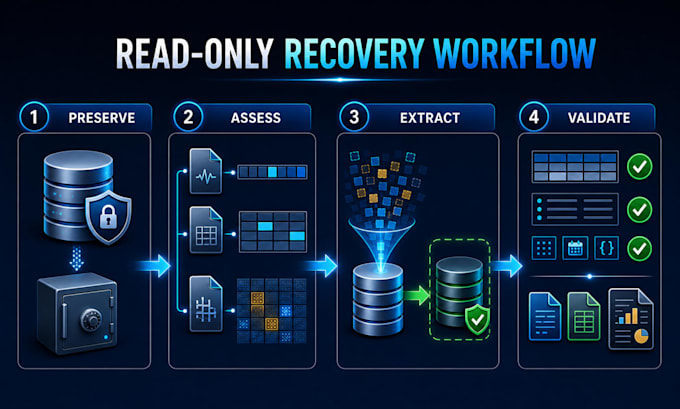
I first preserve the evidence and map the incident timeline. Depending on the case, I analyze system catalogs, filenode relationships, relation files, WAL, table structure, indexes, TOAST references and remaining pages. Recovery work is performed on a copy or isolated environment whenever possible.
Possible deliverables include SQL, COPY or CSV exports, reconstructed object structure, row and type validation, and a concise recovery report.
Recovery is best-effort. Results depend on later object creation, file reuse, checkpoints, WAL retention, VACUUM, PostgreSQL version and media condition. No outcome can be guaranteed.
Before ordering, stop writes if safe, preserve PGDATA and pg_wal, and do not recreate an object with the same name on the only source.
Only systems and data you own or are authorized to administer.



Database type:
Relational database
Is DROP recovery the same as DELETE recovery?
No. DELETE is row-level DML. DROP and TRUNCATE change object or storage relationships, so recovery depends more heavily on catalogs, filenodes, relation files, WAL and object structure.
Can a dropped table always be recovered?
No. Later file reuse, checkpoints, storage writes and missing structure can destroy required evidence. A prompt read-only assessment gives the best chance.
What should I preserve?
Preserve a full PGDATA copy or snapshot, pg_wal, PostgreSQL logs, exact version/build, DDL, backups and any surviving relation files. Do not recreate the object on the only copy.