How Much Does It Cost to Hire an Accountant?
Accountant costs in 2026 range from $40 to $280 based on service complexity, with hourly rates between $7 and $150 across marketplace platforms.
 March 12, 2026
 8 minute reading
In 2026, businesses of all sizes increasingly rely on professional accounting support to navigate complex financial regulations, optimize tax strategies, and maintain accurate financial records. The shift toward remote work and digital collaboration has made it easier than ever to access qualified accounting professionals who can deliver services ranging from basic bookkeeping to comprehensive financial analysis. As regulatory requirements continue to evolve and financial transparency becomes crucial for business success, companies are prioritizing expert financial management to ensure compliance and drive strategic decision-making.
Understanding what you'll pay for accounting services depends on several variables, including the scope of work, the professional's expertise, and whether you need ongoing support or project-based assistance. Current marketplace data shows that basic accounting tasks start around $30 for simple jobs, while specialized services like fractional CFO work or comprehensive financial modeling can reach $280 or more. This guide breaks down the pricing landscape for accounting services in 2026, examines the factors that influence costs, and helps you determine which pricing model and service level align with your business needs and budget.
Average Accountant Costs
Based on recent Fiverr marketplace data, accounting service costs vary significantly depending on the type of work required. For general accounting services, fixed-price projects average around $92, making them accessible for small businesses needing one-time assistance. Bookkeeping services, which involve ongoing transaction recording and account reconciliation, typically cost around $183 for fixed-price engagements, with hourly rates ranging from $48 to $100 and an average project value of $401.
Payroll management represents one of the more affordable accounting functions, with fixed prices averaging $40 and hourly rates around $30, suitable for small teams with straightforward payroll needs. Financial reporting services, essential for businesses requiring regular statements and analysis, show fixed pricing around $139 with hourly rates between $30 and $49, and average project costs of $315.
For businesses requiring strategic financial guidance, fractional CFO services command premium pricing with fixed rates around $228 and hourly rates ranging from $12 to $150, with average project values reaching $1,700. This reflects the senior-level expertise and strategic value these professionals bring to growing companies.
Tax-related services show distinct pricing patterns across specializations. Tax planning services average $129 for fixed-price projects, with some hourly engagements at $95 and average project costs of $578. Tax compliance services cost around $130 on average, while tax return preparation shows similar pricing at approximately $140, with hourly rates spanning from $7 to $150 depending on complexity. Tax identification services, which help businesses obtain necessary tax credentials, typically cost around $85 for straightforward applications.
Financial planning and analysis services cater to businesses needing forward-looking insights. Budgeting and forecasting services average $150 for fixed projects, with hourly rates between $7 and $25 and typical project values around $251. Financial modeling, which requires advanced analytical skills, commands higher rates with fixed prices around $221, hourly rates from $18 to $100, and average project costs of $1,532. General financial planning and analysis services show fixed pricing around $278, reflecting the comprehensive nature of this strategic work.
Which pricing model is best for you?
Fixed-price packages work best when you have clearly defined accounting needs with predictable scope, such as monthly bookkeeping for a set number of transactions, quarterly financial reporting services, or annual tax return preparation. This model provides cost certainty and works well for routine, repeatable tasks where both you and the professional can accurately estimate the time and effort required.
Hourly pricing makes more sense for ongoing advisory relationships, complex projects with uncertain scope, or situations requiring flexible support. This model benefits businesses that need strategic guidance where the time investment may vary, such as financial restructuring, multi-year tax planning, or fractional CFO services where the professional responds to evolving business challenges. Hourly arrangements also suit businesses ramping up accounting support and not yet ready to commit to fixed monthly retainers.

Factors That Influence Accounting Costs
Transaction Volume and Business Complexity
The number of monthly transactions directly impacts pricing for services like bookkeeping and payroll management. A small consultancy with 20 transactions monthly might pay $150 to $200 monthly for basic bookkeeping, while a retail business processing 500 transactions could expect costs between $400 and $600 monthly. Businesses operating across multiple locations, currencies, or legal entities see costs increase by 30 to 50 percent due to consolidation requirements and complex reconciliation needs. Companies with inventory management requirements add another layer of complexity, typically increasing monthly bookkeeping costs by $100 to $300 depending on inventory turnover rates and tracking sophistication.
Industry Specialization Requirements
Accountants with expertise in regulated industries like healthcare, construction, or nonprofits typically charge 20 to 40 percent more than generalists due to specialized knowledge of industry-specific accounting standards, compliance requirements, and reporting frameworks. An accountant familiar with nonprofit fund accounting and Form 990 preparation might charge $175 to $250 for services that a general accountant would price at $125 to $175. E-commerce businesses requiring integration with multiple payment platforms, inventory systems, and marketplace accounting need specialists who understand revenue recognition across channels, justifying premium rates that run 25 to 35 percent higher than standard retail accounting.
Credentials and Professional Experience
Certified Public Accountants command rates 40 to 60 percent higher than non-certified bookkeepers, reflecting their advanced training, regulatory knowledge, and ability to provide attestation services. A CPA might charge $100 to $150 hourly for tax planning, while a tax preparer without certification might charge $50 to $75 for similar work. Professionals with 10-plus years of experience in specific domains like international taxation or merger accounting charge rates at the upper end of pricing ranges, often 50 to 80 percent above entry-level professionals. Specialists holding additional credentials such as Certified Management Accountant or Chartered Financial Analyst designations justify premium pricing through their strategic advisory capabilities beyond basic compliance work.
Service Timing and Urgency
Accounting work required during peak tax season, typically January through April, often carries rush premiums of 25 to 50 percent compared to off-season pricing. A tax return that might cost $300 if filed in February could run $375 to $450 if rushed in mid-April. End-of-year financial close services needed within compressed timeframes similarly command premium rates. Businesses requiring same-week turnaround on financial statements or analysis can expect to pay 30 to 40 percent more than standard two-week delivery timelines. Ongoing monthly services contracted outside peak periods often secure better rates than ad-hoc urgent requests.
Technology Integration and System Complexity
Businesses using standard accounting platforms like QuickBooks Online or Xero generally pay baseline rates, while those requiring custom ERP system knowledge, legacy software expertise, or multiple system integrations see costs increase by 20 to 35 percent. Initial setup and chart of accounts configuration for a standard small business might cost $300 to $500, while complex multi-entity setups with custom reporting requirements can run $1,000 to $2,000. Accountants managing businesses with sophisticated inventory systems, job costing requirements, or project-based accounting charge additional fees reflecting the specialized knowledge and time required to maintain accuracy across complex data structures.
Costs by Service Scope
Basic Bookkeeping and Transaction Recording
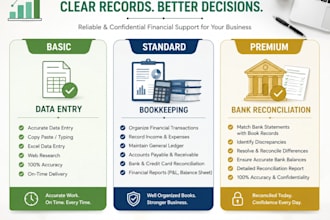
- Monthly transaction categorization, bank reconciliation, and accounts payable/receivable tracking for businesses with under 100 monthly transactions
- Typical cost range: $150 to $300 monthly for ongoing services, or $30 to $50 hourly for ad-hoc support
- Best for: Startups, solopreneurs, and small service businesses with straightforward finances needing accurate records without extensive analysis
Comprehensive Monthly Accounting
- Full-service bookkeeping including transaction recording, reconciliation, accounts management, monthly financial statements, and basic variance analysis for businesses with 100 to 500 transactions monthly
- Typical cost range: $400 to $800 monthly for fixed arrangements, or $50 to $80 hourly depending on complexity
- Best for: Growing small businesses, professional services firms, and retailers requiring regular financial visibility and prepared statements for lending or investor relations
Tax Preparation and Compliance
- Preparation of business tax returns including income statements, balance sheets, and required schedules, along with basic tax compliance guidance for standard business structures
- Typical cost range: $400 to $1,200 for small business returns depending on entity type and complexity, with simple sole proprietor returns at lower end and multi-state corporations at higher end
- Best for: Established businesses with relatively straightforward tax situations needing annual return preparation and basic planning to minimize tax liability
Strategic Tax Planning
- Proactive multi-year tax strategy development, entity structure optimization, timing strategies for income and expenses, and scenario modeling to minimize overall tax burden
- Typical cost range: $800 to $2,500 for comprehensive planning engagements, or $95 to $150 hourly for ongoing advisory relationships
- Best for: Profitable businesses with significant taxable income, companies considering major transactions or restructuring, and owners seeking to optimize personal and business tax positions
Financial Analysis and Reporting
- Custom financial reporting beyond standard statements, including KPI dashboards, profitability analysis by product or service line, cash flow forecasting, and management reporting packages
- Typical cost range: $500 to $1,500 monthly for regular reporting packages, or $60 to $100 hourly for project-based analysis
- Best for: Mid-sized businesses requiring decision-support analytics, companies preparing for funding rounds, and organizations needing detailed performance insights beyond basic financials
Fractional CFO Services
- Strategic financial leadership including financial planning, budgeting and forecasting, capital raising support, board reporting, financial systems design, and executive-level guidance on financial strategy
- Typical cost range: $1,500 to $4,000 monthly for part-time CFO support, or $125 to $200 hourly depending on experience and company complexity
- Best for: Growing companies not ready for full-time CFO expense, businesses navigating significant transitions, and organizations requiring senior financial expertise for strategic initiatives
Related Services Costs
















































































Payroll Processing
Payroll management services handle employee compensation calculations, tax withholdings, regulatory filings, and payment distribution. These services integrate closely with accounting functions since payroll represents a significant expense category requiring accurate recording and reporting. Businesses typically need dedicated payroll support when they hire their first employees or when managing payroll in-house becomes too time-consuming or risky given compliance requirements. Standard payroll processing for small teams of 5 to 15 employees typically costs $75 to $150 monthly plus per-employee fees, while businesses with complex payroll needs involving multiple states, contractor payments, or benefits administration might invest $200 to $400 monthly.
Financial Forecasting and Budgeting
Budgeting and forecasting services help businesses plan future performance through detailed projections of revenue, expenses, and cash flow. This forward-looking work complements historical accounting by translating past performance into actionable plans for resource allocation and growth strategies. Companies typically engage finance professionals for budgeting when preparing annual plans, seeking funding, or experiencing rapid growth requiring careful cash management. Annual budget development for small to mid-sized businesses generally costs $800 to $2,000, while ongoing quarterly forecast updates run $300 to $600 per cycle depending on business complexity and the level of scenario analysis required.
Financial Modeling
Financial modeling creates detailed numerical representations of business performance under various scenarios, supporting strategic decisions like expansion plans, pricing strategies, or investment evaluations. This specialized service requires advanced spreadsheet skills and business acumen beyond standard accounting, making it valuable for companies making significant strategic decisions. Businesses engage modeling experts when evaluating major investments, preparing for fundraising, or analyzing potential acquisitions. Custom financial models for business planning typically cost $1,000 to $3,000 depending on complexity, while sophisticated models supporting fundraising or M&A transactions can range from $2,500 to $7,500 based on the detail and scenario analysis required.
Accounts Receivable and Collections
Dedicated accounts receivable management focuses on invoice generation, payment tracking, customer communication regarding outstanding balances, and collection activities for overdue accounts. While basic AR tracking falls under standard bookkeeping, businesses with significant customer bases or collection challenges benefit from specialized support. This service becomes valuable when outstanding receivables impact cash flow or when internal resources cannot maintain consistent collection efforts. Monthly AR management for businesses with 20 to 50 active customer accounts typically costs $200 to $400, with pricing scaling based on invoice volume and the intensity of collection efforts required for aging accounts.
Internal Controls and Process Documentation
Internal controls consulting helps businesses design and implement processes that protect assets, ensure accurate financial reporting, and prevent fraud. This service intersects with accounting by establishing the systems and procedures that accountants rely on for accurate data. Companies typically need controls consulting when experiencing rapid growth, preparing for audits, or after identifying weaknesses in financial processes. A basic internal controls assessment and documentation project for a small business runs $1,500 to $3,500, while comprehensive programs involving process redesign, segregation of duties analysis, and ongoing monitoring support might cost $5,000 to $12,000 depending on organizational complexity.
Ongoing Costs and Hidden Expenses
Beyond the base fees for accounting services, businesses should budget for additional expenses that often accompany professional financial management. Understanding these costs upfront prevents budget surprises and helps you accurately assess total investment requirements.
- Accounting software subscriptions ranging from $30 to $200 monthly depending on features and user count, required for cloud-based collaboration with your accounting professional
- Document management and receipt tracking tools costing $10 to $50 monthly, streamlining information sharing and maintaining organized records for tax and audit purposes
- Additional consultation time beyond base packages for special projects, typically billed at hourly rates, such as audit support, regulatory inquiries, or financial due diligence
- Year-end adjustment work and tax preparation coordination, which may incur extra fees of $200 to $600 if your regular accounting package covers only monthly maintenance
- Multi-state tax registration and compliance for businesses operating across state lines, adding $150 to $400 per additional state annually for registration and ongoing filing requirements
- Amended return preparation if errors are discovered or new information emerges, typically costing 50 to 75 percent of original return preparation fees
- Sales tax compliance services for businesses selling across multiple jurisdictions, ranging from $100 to $500 monthly depending on filing frequency and jurisdiction count
- Professional liability insurance recommendations from your accountant that protect your business, adding modest annual costs but providing valuable risk mitigation
Frequently Asked Questions
How much does accounting support cost on Fiverr?
Accounting services on the platform range from around $30 for basic tasks like transaction categorization or simple financial statement preparation to $280 or more for comprehensive packages involving strategic financial analysis or fractional CFO support. Entry-level bookkeeping services typically start around $150 to $200 for monthly maintenance of straightforward books, while mid-tier packages offering financial reporting and analysis run $300 to $600 monthly. Premium services like tax planning, financial modeling, or executive-level financial guidance command higher rates reflecting specialized expertise, with project costs frequently exceeding $1,000 for comprehensive deliverables. Many professionals offer tiered packages allowing you to select the service level matching your current needs and budget, with options to expand services as your business grows.
What are typical hourly rates for accounting professionals?
Hourly rates for accounting work vary from $47 to $150 depending on the professional's credentials, specialization, and the complexity of work involved. Basic bookkeeping and data entry tasks fall at the lower end of this range, typically $30 to $40 hourly, suitable for routine transaction recording and account reconciliation. Mid-level accounting work including financial reporting, payroll management, and tax return preparation generally runs $40 to $80 hourly, reflecting greater expertise and analytical requirements. Strategic services like tax planning, financial analysis, and fractional CFO support command premium hourly rates between $95 and $150, justified by advanced credentials and the high-value guidance these professionals provide. Hourly pricing works best when project scope remains uncertain or when you need flexible ongoing support rather than defined deliverables, allowing you to scale investment up or down based on changing business needs.
What is typically included in a basic accounting package?
A standard basic accounting package generally includes monthly transaction categorization, bank and credit card reconciliation, accounts payable and receivable tracking, and basic financial statement generation showing your profit and loss and balance sheet. Most basic packages accommodate businesses with up to 100 monthly transactions and assume you use standard accounting software with relatively straightforward chart of accounts. Premium additions often offered as upgrades include cash flow statements and analysis, budget versus actual reporting, customized management reports, accounts receivable aging analysis, and detailed profitability breakdowns by product, service, or department. Additional scope like multi-entity consolidation, inventory accounting, job costing, or industry-specific reporting typically moves you into mid-tier or custom packages with correspondingly higher pricing. The cost difference between basic and expanded packages usually ranges from 40 to 100 percent depending on the additional complexity and deliverables you require.

Related Guides




About the author
Gili Baruch-KlystAI growth specialist
A growth specialist on Fiverr’s Growth team, combining deep SEO expertise with advanced AI capabilities to drive scalable, data-driven performance.
