Browse categories
English
$
USD
Connect to your AI


Are your AI APIs timing out? Is your Python backend blocking the main thread?
As an AI Infrastructure Developer, I specialize in building ultra-low-latency, enterprise-grade AI backends that scale. Most developers just wrap an OpenAI call in a Flask app, which leads to rate limits, O(N²) bottlenecks, and resource leaks. I build asynchronous engines that don't crash.
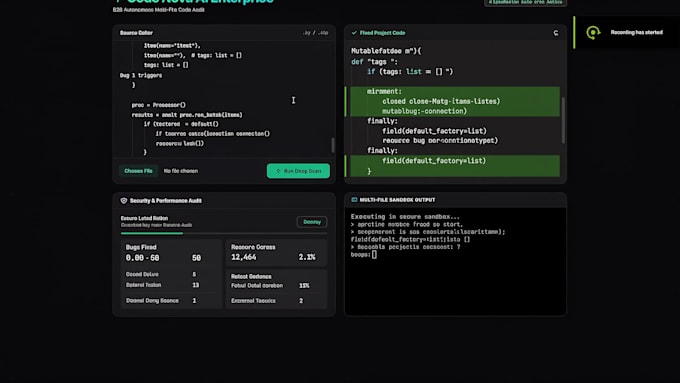
What I Bring to the Table: ️ Ultra-Fast LLM Inference: LangChain pipelines routed through Groq (Llama-3) or OpenAI. ️ Non-Blocking Architecture: Fully asynchronous FastAPI integration. ️ Enterprise Code Quality: Built-in safeguards against state-sharing bugs and resource leaks. ️ Custom Logic: RAG pipelines, autonomous agents, and code auditing engines (Check my gig video for a live demo of my custom engine, Code Nova).
Tech Stack: Python, FastAPI, LangChain, Llama-3/Groq, Pandas, PyTest, Streamlit.
If you are a startup founder or CTO looking to build or optimize your AI backend without the typical freelance headaches, let's talk.
Please send a message before placing an order so we can discuss your specific infrastructure needs.
Python Backend AI Integration Developer
Languages
Do you use standard OpenAI APIs or can you integrate open-source models?
I use LangChain, which allows seamless integration with both OpenAI and open-source models like Llama-3. For ultra-low latency and avoiding standard API bottlenecks, I highly recommend using Llama-3 via Groq's LPUs, which I specialize in.
Why do you prefer FastAPI over Flask for AI backends?
AI inference calls take time. FastAPI is fully asynchronous (ASGI), meaning it doesn't block the main event loop while waiting for the LLM to respond. This prevents API timeouts and keeps your infrastructure scalable under heavy load.
What exactly is included in the "AI Backend Audit" package?
I will review your existing Python codebase to detect O(N²) time complexity bottlenecks, resource leaks (like unclosed connections missing finally blocks), and state-sharing bugs (like mutable default arguments), and provide the patched, production-ready code.
Do I need to provide the API keys for the LLMs?
Yes, you will need to provide your own API keys (OpenAI, Groq, etc.). I will set them up securely using standard .env environments so your credentials are never hardcoded or exposed in the source code.