Browse categories
Explore
Fiverr Pro
English
$
USD
MATLAB and ML Solutions Tailored for Your Success!
Level 1
Has met certain performance criteria and shows strong potential in the marketplace.
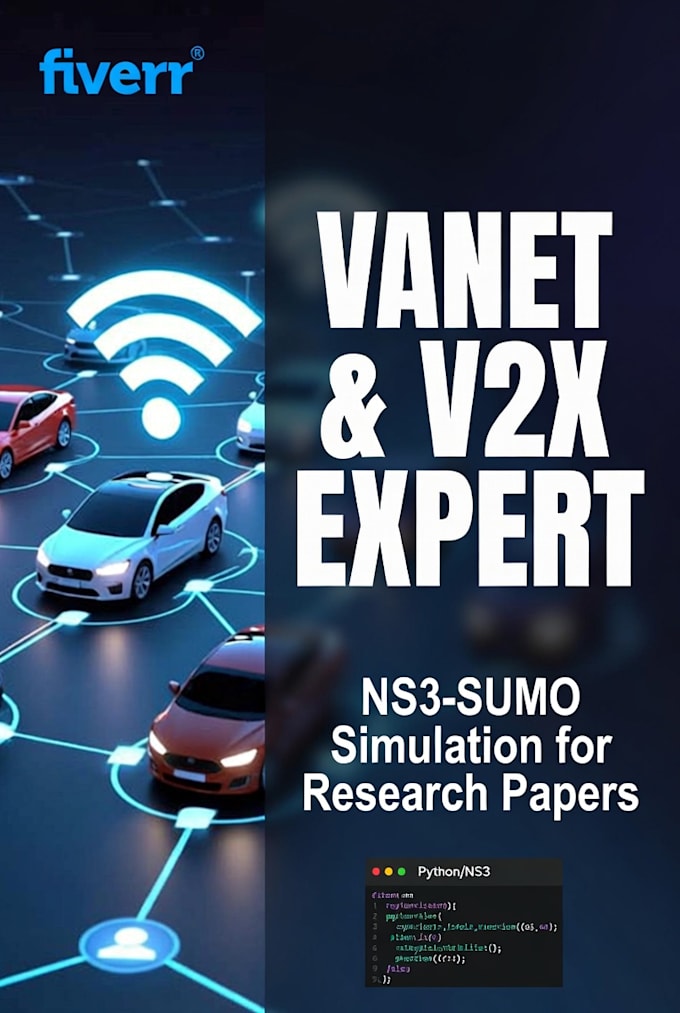
NS-3 SUMO VANET V2X C-V2X Simulation for Research, Thesis & ITS
Are you working on Intelligent Transport Systems (ITS)?
I will bridge the gap between traffic mobility and network communication to provide a high-fidelity V2X (Vehicle-to-Everything) simulation.
What I offer:


Which versions of NS-3 and SUMO do you use? .
I typically work with the latest stable releases, such as NS-3.41+ and SUMO 1.21+. however, if your research requires an older environment (like NS-3.29 or NS-2.35) for specific legacy modules, I can configure those environments using Docker or virtual machines to ensure full compatibility
Can you simulate specific real-world locations?
Yes! I use OpenStreetMap (OSM) to export real-world city maps and road networks. I then process these through the netconvert and polyconvert tools in SUMO to ensure that the lane logic, traffic lights, and intersections match the real-world location exactly.
Do you support 5G-V2X (C-V2X) or just WAVE (802.11p)?
I support both. For standard DSRC/WAVE simulations, I use the IEEE 802.11p module. For advanced cellular V2X (C-V2X), I integrate the 5G-LENA or mmWave modules in NS-3 to simulate Sidelink (PC5 interface) communications and network slicing for vehicular safety.
What kind of mobility models can you implement?
I provide realistic mobility using SUMO's Krauss car-following model and LC2013 lane-changing model. Unlike simple random-waypoint models, my simulations account for traffic congestion, vehicle acceleration, and real-driver behavior, which is critical for valid V2X research data.
Can you simulate C‑V2X (LTE‑V2X) Mode 3 or Mode 4 in NS3 with SUMO?
Yes. I implement C‑V2X Mode 4 (sensing‑based semi‑persistent scheduling) for vehicle‑to‑vehicle communication, and Mode 3 if you need eNB‑assisted scheduling. I can also compare IEEE 802.11p (WAVE) vs C‑V2X vs 5G‑V2X within the same NS3‑SUMO simulation framework. Just specify which protocols you nee
Do you work with real‑world maps from OpenStreetMap (OSM)?
Absolutely. I can import real OSM maps (e.g., downtown Luxembourg, Cologne, Manhattan, or any city you provide) into SUMO using netconvert. I also handle traffic lights, speed limits, lane numbers, and intersection geometries. The mobility traces are then fed directly into NS3 for your VANET or V
What performance metrics will I receive in the output?
You will receive raw trace files and publication‑ready graphs for: Packet Delivery Ratio (PDR) vs vehicle density / speed End‑to‑End Delay (E2E) – average and distribution Throughput (MAC‑layer and application‑layer) Channel Busy Ratio (CBR) – for 802.11p and C‑V2X Beacon Error Rate (BER) and h
Can you simulate V2I with custom RSU placement and handover?
Yes. In the Premium package, I place Roadside Units (RSUs) at intersections or along highways according to your coverage requirements. I can also simulate handover between RSUs (or between RSU and base station for C‑V2X Mode 3) and measure handover latency, packet loss, and connection time. For cust
| (1) | ||
| (0) | ||
| (0) | ||
| (0) | ||
| (0) |
akramakram1998

Canada
Very good joob
$200-$400
Price
4 weeks
Duration
| (1) | ||
| (0) | ||
| (0) | ||
| (0) | ||
| (0) |
akramakram1998
Canada
Very good joob
$200-$400
Price
4 weeks
Duration