Browse categories
English
$
USD
Connect to your AI



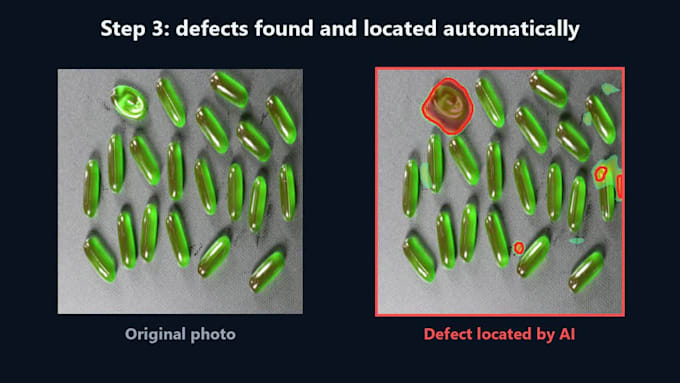
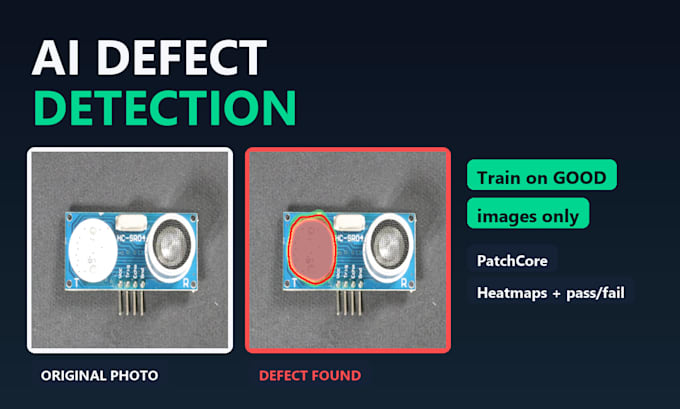
Finding product defects by eye is slow and inconsistent. I build AI visual inspection models that automatically spot scratches, cracks, dents, missing parts, stains and misprints.
The key difference: you do NOT need hundreds of defect photos. Using anomaly detection (PatchCore, PaDiM, FastFlow via Anomalib), the model learns what a GOOD product looks like from as few as 50-200 normal images, then flags anything unusual and highlights where.
You get:
- Trained anomaly detection model for your product
- Defect heatmaps and pass/fail decision with adjustable threshold
- Evaluation report (AUROC, recall, false-alarm rate)
- Python inference script (images, folders, live camera)
- Exported model (ONNX / OpenVINO) on higher packages
- Demo video on your samples
Ideal for: PCB and electronics, 3D printing, textiles, metal parts, packaging, bottles, food, tiles, wood.
Tools: Python, PyTorch, Anomalib, OpenCV, ONNX.
Message me first with 5-10 sample photos and I'll tell you honestly if it's feasible. Results depend on image quality. Demo images: VisA dataset (CC BY 4.0).
Clean Code, Smart Solutions
Languages
Q1: How many images do I need?
A: For normal (good) products, 50-200 images is usually enough to start. More images make the model more stable.
Q2: Do I need photos of defective products?
A: No, that is the main advantage of anomaly detection. A few defect samples (5-20) help me measure accuracy and set the threshold.
Q3: What image quality do I need?
A: Consistent lighting, camera angle and distance matter most. I’ll send a short capture guide after you order.
Q4: Which defects can it catch?
A: Scratches, stains, cracks, missing or misplaced parts, and texture or color irregularities. Very small defects need higher-resolution images.
Q5: Can it run in real time on a production line?
A: Yes, on a GPU or a modern CPU with a lightweight model. Speed depends on resolution and hardware, and I’ll report it for your setup.
Q6: Can you guarantee 100% accuracy?
A: No. You get a full metrics report with false-alarm and missed-defect rates, and I’ll tell you upfront if the job isn’t feasible.
Q7: Will my data stay private?
A: Yes. Your images are used only for your project and never shared. I’m happy to sign an NDA.
Q8: What do I receive at delivery?
A: Trained model, defect heatmaps, inference script, evaluation report and a short README. Higher packages add ONNX export and a demo app.