Browse categories
English
$
USD
Connect to your AI



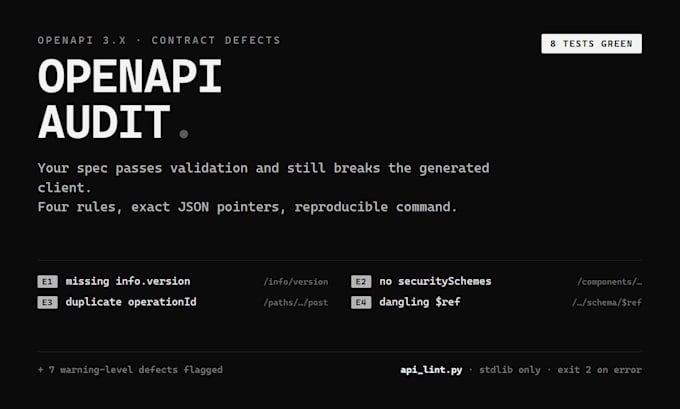
Your OpenAPI file looks fine until a generator or a partner integration hits it, and then something breaks silently. I run a rule-based audit and hand you every finding with an exact JSON pointer, so each line maps to a real place in your spec.
What I check:
- Structural validity: info.version, servers, path and operation keys, parameter consistency
- Operation IDs: duplicates, missing, or names that collide in generated clients
- References: dangling $ref, circular refs, refs pointing into the wrong file
- Schemas: required versus nullable conflicts, missing type, enums that drift from responses
- Responses: missing 4xx and 5xx, wrong content types, undocumented headers
- Security: missing securitySchemes, operations that inherit auth by accident
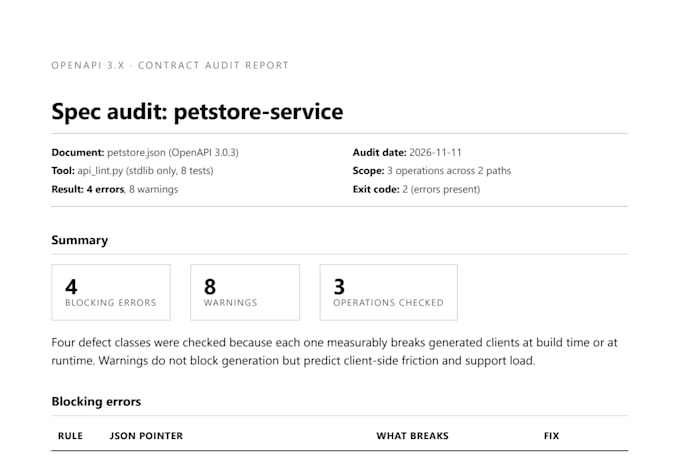
What you receive: a written PDF grouped by severity. Every finding carries the JSON pointer, why it breaks clients, and the exact fix. Standard adds a prioritized fix list, Premium adds a CI gate that fails the build on new spec breakage.
Async by default: you send the spec, I send the report and written steps, follow-ups in chat. No calls. Read-only audit - I never change your file without asking.
Python Automation and API Audits, Windows and Data Pipelines
Languages
What format do you need the spec in?
YAML or JSON, either is fine. OpenAPI 3.x preferred; Swagger 2.0 works too, I convert it before auditing.
Do you fix the spec or only report?
Report by default. Standard and Premium include the exact edits; Premium also wires the check into your CI so new breakage fails the build.
How do you handle a private spec?
Send only what is needed. The rules work the same on a redacted copy, so internal hosts can be removed before sharing.