Browse categories
Explore
Fiverr Pro
English
$
USD
Data extraction with human QA built in Los Angeles
Stop copy-pasting. Get a database.
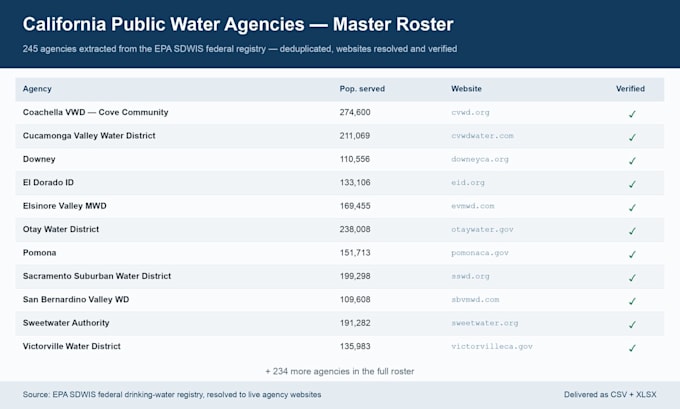
You have a website, directory, or listing page. You need it in Excel clean, deduplicated, and usable. That's what I deliver.
What you get:
What I extract: business directories, member lists, exhibitor pages, product catalogs, real-estate listings, government registries, review sites if it's publicly listed, I can structure it.
My process: automated extraction + human QA. Automation makes it fast and affordable; the QA pass is why my files don't have the garbage rows pure-bot services deliver.
Before you order: send the URL and the fields you need. I'll confirm feasibility and record count within hours no surprises, no scope games.
What I don't do: login walls, CAPTCHA bypass, personal data beyond public business listings, or anything against a site's terms. If your source is protected, I'll say so upfront instead of delivering junk.


Technology:
Python
•
Scrapy
•
Selenium
•
Beautiful soup
•
Playwright
Technique:
Automated
Can you get email addresses?
I extract emails that are publicly listed on the source site (e.g., a directory that displays contact emails). I don't guess, generate, or harvest personal emails from elsewhere.
The site is huge — 50,000 records. Can you do it?
Yes — message me for a custom offer. My listed packages cap at 5,000 records to keep delivery times honest.
The site loads content with JavaScript / infinite scroll.
Usually fine — I handle dynamically loaded pages. Send the URL and I'll confirm before you order.
What format do I get?
CSV and XLSX, UTF-8, one row per record. Google Sheets link on request.
Is this legal?
I extract only publicly displayed information, respect robots/rate limits, and decline sources whose terms prohibit extraction. You're responsible for how you use the data (e.g., outreach compliance in your jurisdiction).