Browse categories
Explore
Fiverr Pro
English
$
USD

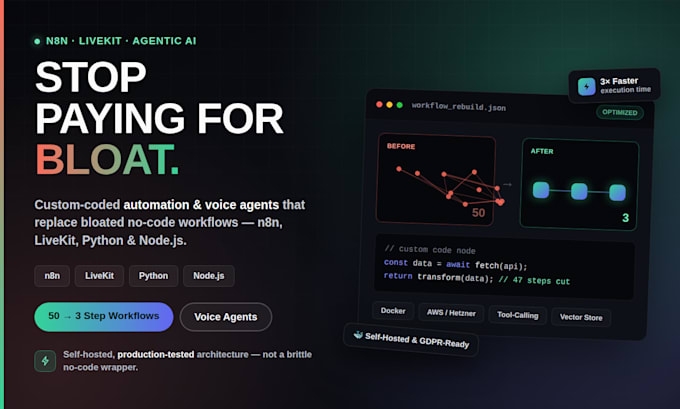
Are you trying to build AI voice agents, cloning, AI dubbing, or agentic automation but keep running into API limits, high per-character costs and limits, complex tool-calling, and unreliable workflows?
I build scalable self-hosted AI models using APIs, open-source models, custom Python/Node.js services, GPUs and production-ready applications.
WHAT I CAN BUILD:
Self-Hosted Voice AI & Voice Cloning
AI Dubbing & Translation Pipelines
Full-Stack AI Voice Platforms
Vapi/ Retell/ LiveKit AI Agents low-latency
Custom Middleware & AI Agentic
Reach Out To Me Now!!!
Full Stack AI Engineer Voice Engineering ChatBot App BcakEnd Engineering
Languages
Can you build voice cloning without relying entirely on ElevenLabs?
Yes. I can build either API-based or self-hosted voice cloning systems depending on your requirements. For projects requiring greater control over usage, cost, privacy, or scalability, I can deploy open-source models such as F5-TTS, XTTS-v2, or CosyVoice on GPU infrastructure.
Can you build a voice cloning platform with no third-party character limits?
Yes. A self-hosted architecture can reduce dependence on third-party per-character or usage-based limits. Your actual capacity will depend on the selected model, GPU resources, concurrency, audio quality, and infrastructure configuration.
Can you build an AI dubbing system for videos?
Yes. I can build an automated AI dubbing pipeline that processes audio/video, transcribes speech, detects speakers, translates the content, generates cloned voices, synchronizes the audio, and produces the final dubbed media.
What technology do you use for AI dubbing?
Depending on the project, I can combine Whisper for speech-to-text, speaker diarization, translation models/APIs, F5-TTS, XTTS-v2, CosyVoice or ElevenLabs for voice synthesis, and FFmpeg for audio/video processing and alignment.
Can you build both the frontend and AI backend?
Yes. I can handle the complete full-stack implementation, including a Next.js/React dashboard, Python FastAPI backend, AI processing engine, database, authentication, file storage, GPU workers, APIs, and deployment infrastructure.
Can you deploy AI voice models on RunPod or AWS GPUs?
Yes. I can design and deploy GPU-based AI infrastructure using platforms such as RunPod or AWS. The architecture can be optimized for voice generation, cloning, dubbing, concurrent processing, and scalable workloads.
Can I still use ElevenLabs in a custom voice platform?
Yes. ElevenLabs can be integrated alongside self-hosted models where it provides advantages in voice quality, cloning, multilingual support, or specific features. The architecture can be designed so the platform is not unnecessarily dependent on a single provider.
Can you build multilingual AI voice and dubbing systems?
Yes. I can build multilingual pipelines that combine speech recognition, translation, speaker handling, voice cloning/TTS, and audio alignment. Supported languages and voice quality depend on the models and services selected for your project.
Can you integrate AI voice systems with automation and business tools?
Yes. I can connect AI voice systems with n8n, Make, webhooks, REST APIs, CRMs, calendars, databases, SMS/email systems, and other business applications to automate actions after or during conversations.
Can you build a proof of concept before developing the complete platform?
Yes. For complex voice cloning or dubbing platforms, I recommend starting with a focused proof of concept. This allows us to validate voice quality, language support, speaker handling, processing speed, synchronization, and GPU requirements before investing in the complete production system.