What Is Agentic AI? A Complete Guide to AI Agents & How They Work
Learn about the core definition of what Agentic AI is, and how it helps businesses move quicker today.
 April 29, 2026
 8 minute reading
Artificial intelligence has come a long way from simply answering questions or completing isolated tasks. Today, a new generation of AI systems is capable of setting goals, making decisions, and taking sequences of actions, and all with minimal human input. This is the world of agentic AI, and it is rapidly changing how businesses operate, build, and scale.
Whether you have been hearing the term more frequently or are encountering it for the first time, this guide breaks down what agentic AI is, how AI agents work, and why forward-thinking companies are already putting them to use.
If you want to understand the reasoning engine that powers most AI agents, read our guide on ‘What is an LLM?’
What Is Agentic AI?

Photo by Google Deepmind | Pexels.com
At its core, agentic AI refers to artificial intelligence systems that can act autonomously to achieve a defined goal. Rather than simply responding to a single prompt and stopping, an agentic AI system plans, makes decisions, executes tasks, evaluates its own progress, and adjusts its approach, all in pursuit of a broader objective.
It helps to understand the distinction between two terms that are often used interchangeably but mean different things.
An AI agent is an individual, task-focused entity: a software component built to perceive context, reason toward a goal, and take action.
Agentic AI is the broader system in which one or more of these agents operate in a coordinated way to achieve higher-level outcomes. Think of AI agents as individual tools in a toolbox, and agentic AI as the organized use of all those tools together to build something.
How Agentic AI Differs from Traditional AI Tools
Traditional AI is largely reactive. You provide an input, a prompt, an image, a dataset, and it returns an output. The interaction begins and ends there.
Agentic AI operates differently. It receives a high-level goal and then works through it independently: breaking the objective into sub-tasks, deciding which tools or resources to use, executing those steps in sequence, checking results, correcting course when needed, and continuing until the goal is achieved. It does not wait for a human to approve each step. It acts.
This distinction is what makes agentic AI a genuinely new capability for businesses, not just a smarter autocomplete, but a system that can carry a complex initiative from start to finish.
How Do AI Agents Work?
An LLM on its own is fundamentally a text generation engine. It takes input and produces output. What transforms it into an agent is the framework or harness it operates within. These are software systems, such as LangChain, AutoGen, or purpose-built proprietary harnesses, that supply the LLM with the tooling, memory infrastructure, and orchestration logic it does not possess by default. The agent architecture is what gives the LLM its ability to plan across steps, retain context, and interact with external systems. Without it, you have a capable language model. With it, you have an agent.
With that framing in place, here is how an AI agent actually functions at a high level. It operates through a continuous loop of five core processes.
- Perception is where the agent takes in information, whether that is text, data pulled from an API, content from the web, files, or the output of a previous step in the workflow.
- Planning is where the agent applies intelligence to that input. Using an LLM as its reasoning engine, the agent determines what needs to happen next, what tools to use, and what sequence of actions will best serve the goal.
- Action is where the agent actually does something, writing a document, executing code, querying a database, browsing a website, or triggering an external service.
- Memory allows the agent to retain context. Short-term memory keeps track of what has happened within a single session. Longer-term memory, where it exists, is typically managed at the framework level rather than being a native capability of the LLM itself, and its reliability varies significantly depending on implementation.
- Learning and adjustment close the loop. The agent evaluates its output, identifies gaps or errors, and retries or refines, iterating until the desired result is achieved or a defined stopping condition is met.
This cycle is what separates a true AI agent from a standard chatbot or automation script. It is dynamic, self-correcting, and goal-directed.
The Role of Tools and Integrations
AI agents do not operate in isolation. Their power comes significantly from the tools and systems they can access and control. A capable AI agent might browse the web to gather research, write and execute code, read and write files, query databases, call external APIs, or trigger downstream workflows in other applications.
It is this ability to use tools in combination that gives agentic AI its practical power. Without tool integration, even the most sophisticated reasoning engine is limited to what it can produce on its own.
Key Types of AI Agents
Not all AI agents are built the same way. Understanding the main architectural types helps businesses make more informed decisions when evaluating or implementing agentic AI solutions.
- Reactive agents are the simplest form. They respond to immediate inputs based on predefined rules or patterns, without maintaining memory of past interactions. They are fast and predictable, but limited in scope.
- Deliberative agents are more sophisticated. They maintain an internal model of their environment and use it to plan ahead, simulating potential outcomes before choosing a course of action. This makes them better suited to complex, multi-step objectives.
- Multi-agent systems take things a step further by deploying networks of specialized agents that work collaboratively. One agent might be responsible for research, another for writing, and another for quality review — each contributing to a shared output. This architecture mirrors how high-performing human teams are structured, with specialists handling different functions in parallel.
- Goal-based and learning-based agents differ in how they pursue objectives. Goal-based agents work toward explicit, predefined targets. Learning-based agents improve their performance over time through feedback and experience, becoming more effective the more they are used.
For most business applications today, the most common implementations involve deliberative agents and multi-agent systems, particularly in areas like software development, content production, and data operations.
Real-World Use Cases for Agentic AI
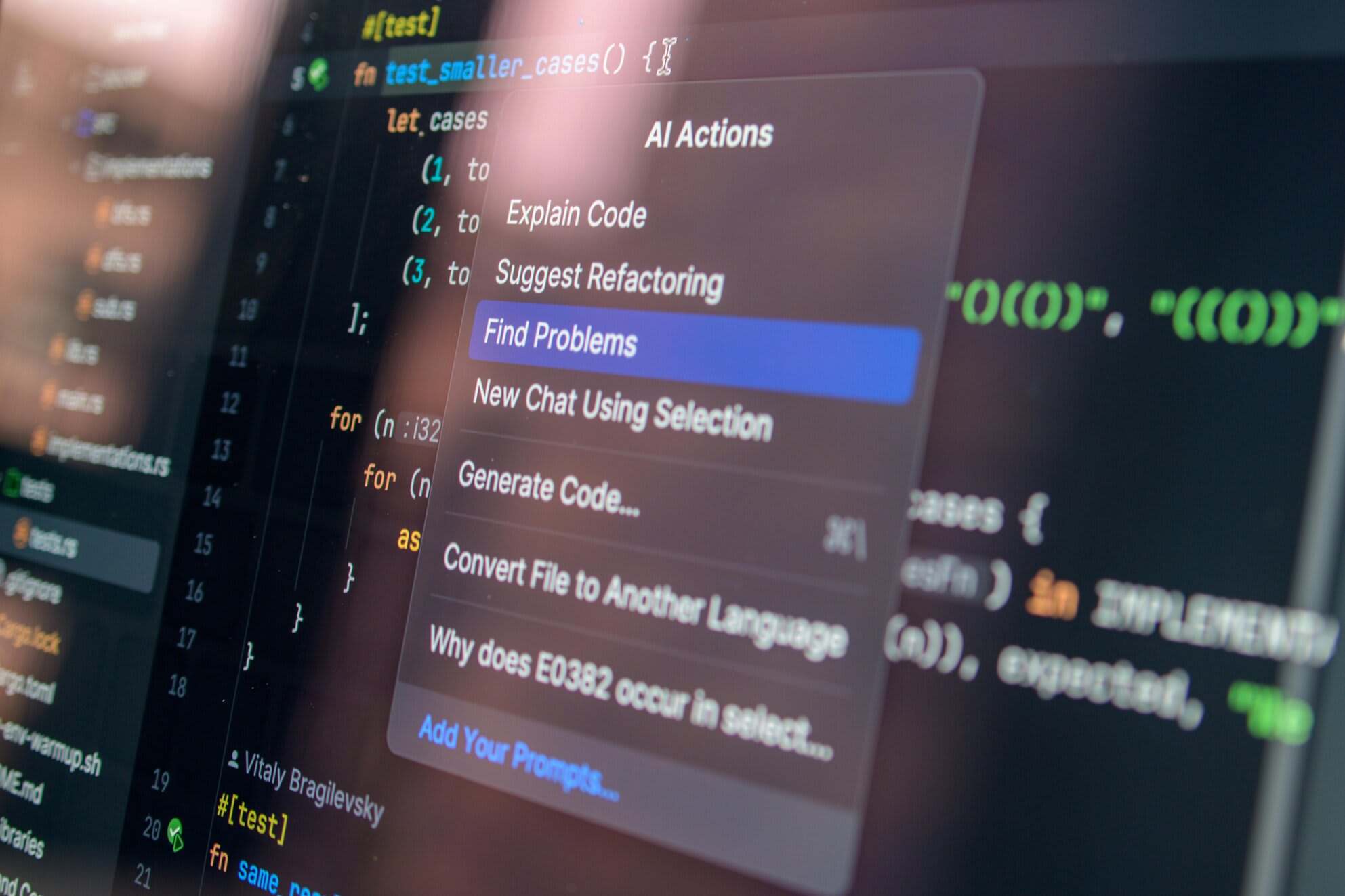
Photo by Daniil Komov | Pexels.com
The value of agentic AI becomes clearest when examined through the lens of practical business application. Across industries and functions, AI agents are already being deployed to handle work that was previously too complex, too time-consuming, or too resource-intensive to automate.
Software Development and Engineering
AI agents are being used to write, test, debug, and refactor code autonomously. Rather than simply generating a code snippet on request, agentic systems can take a feature brief, write the implementation, run tests, identify failures, correct the code, and verify the result, compressing development cycles significantly and reducing the burden on engineering teams for repetitive or lower-complexity tasks.
Digital Marketing and Content Operations
In marketing, multi-agent pipelines are enabling end-to-end content workflows. Agents can research a topic, draft and structure content, optimize for search intent, check brand consistency, and prepare assets for publishing, all within a coordinated, automated sequence. For teams managing high content volumes, this represents a meaningful shift in operational capacity.
Data Analysis and Business Intelligence
AI agents can connect to data sources, run analysis, surface patterns, and generate structured reports, all without requiring a data analyst to manually execute each step. This frees skilled professionals to focus on interpretation and strategy rather than data wrangling.
Customer Support and Workflow Automation
Agentic systems are increasingly handling multi-step support flows: understanding a customer's issue, retrieving relevant information, executing a resolution, and escalating to a human only when genuinely necessary. This enables consistent, around-the-clock support without proportional staffing investment.
Research and Competitive Intelligence
For functions that depend on synthesizing large volumes of information — market research, due diligence, product discovery, regulatory review — AI agents can browse, extract, summarize, and organize at a scale and speed that no human team can match. The output is not just faster; it is more comprehensive.
Benefits of Agentic AI for Businesses
The business case for agentic AI is not built solely on technological novelty. It rests on a set of concrete, measurable advantages that directly affect how organizations grow and compete.
- Scalability is perhaps the most significant. Agentic AI systems can handle increasing workloads without requiring proportional increases in headcount. A single well-designed agent workflow can process in hours what might take a team days.
- Speed is another critical factor. By compressing multi-step processes into automated sequences, businesses can move faster on everything from product development to marketing execution to operational decision-making.
- Consistency reduces the risk of human error on repetitive, rule-based tasks. An agent following a defined workflow will execute it the same way every time, eliminating variability driven by fatigue, distraction, or miscommunication.
- Autonomy frees skilled professionals to focus on higher-value work. When AI agents handle execution, human teams can concentrate on strategy, creativity, and the decisions that genuinely require judgment.
- Adaptability means agentic systems are not rigid. They respond to changing inputs and conditions in real time, adjusting their approach as new information becomes available, something static automation tools simply cannot do.
Together, these advantages position agentic AI not as a tool for efficiency alone, but as a genuine strategic capability for businesses operating in fast-moving markets.
Find Agentic AI Experts on Fiverr
Implementing agentic AI effectively is a complex, high-stakes undertaking. The architecture decisions made early, like how agents are structured, what tools they access, how they are monitored, do have long-term consequences for reliability, security, and scalability. Getting it right from the start is far more cost-effective than rebuilding a flawed system later.
Fiverr Pro connects businesses with manually vetted AI specialists who bring deep expertise in agent architecture, LLM integration, and end-to-end workflow automation. Fiverr Pro is built for the kind of complex, long-term projects that agentic AI implementation demands.
If your business is ready to move from exploring agentic AI to actually building with it, explore vetted AI experts on Fiverr Pro and find the right specialist for your goals.
FAQ
What is agentic AI?
Agentic AI refers to artificial intelligence systems that can autonomously plan, make decisions, and execute sequences of actions to achieve a defined goal, operating independently across complex, multi-step workflows rather than simply responding to individual prompts.
What is the difference between agentic AI and a chatbot?
A chatbot responds to a single input and returns a single output. Agentic AI plans and executes multi-step tasks autonomously, using tools, retaining context, adjusting based on results, and working toward a broader objective — without requiring human input at each step.
What are AI agents used for in business?
AI agents are being applied across software development, digital marketing, data analysis, customer support, and research — anywhere a complex, repeatable workflow can benefit from autonomous execution at scale.
Do I need a technical team to implement agentic AI?
Not necessarily, but working with a vetted AI specialist from Fiverr Pro can accelerate implementation significantly, providing the architectural expertise and integration knowledge needed to build reliable, production-ready agentic systems — without requiring a dedicated in-house AI engineering function.

Related Guides





About the author
Gili Baruch-KlystAI growth specialist
A growth specialist on Fiverr’s Growth team, combining deep SEO expertise with advanced AI capabilities to drive scalable, data-driven performance.
